Features Overview
ProjectAchilles is built around three pillars — develop tests, execute them, and measure the results — each accessible from a unified web interface with Clerk authentication.
Unified Security Dashboard
/dashboard is the console's landing page — one view of posture across the
test library, the endpoint fleet, and Elasticsearch analytics. It replaced the
three separate module dashboards in 2.1.
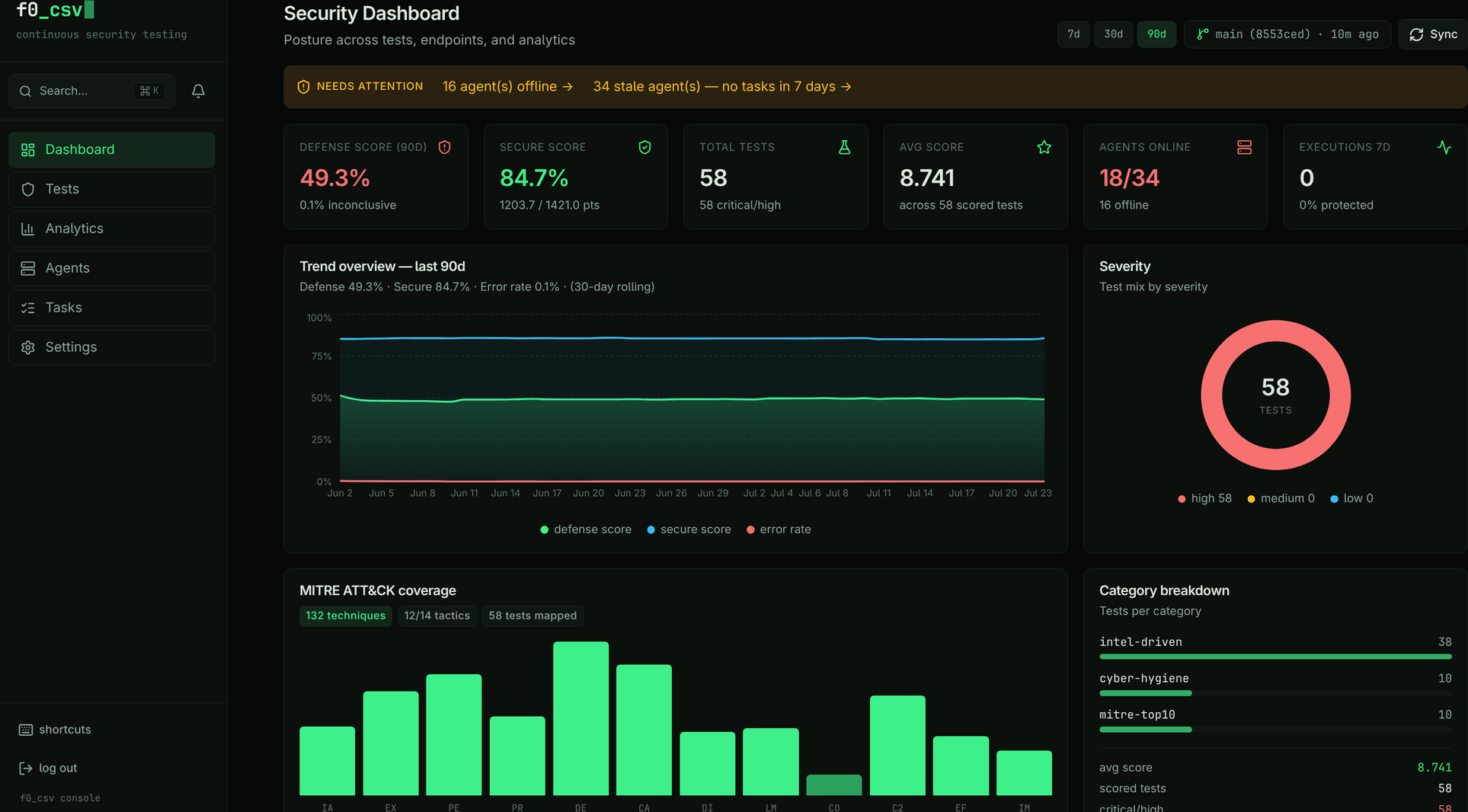
- Attention banner — derived, not stored: offline agents, stale agents, failed tasks in the last 24 h, outdated binaries, and git sync failures, each linking to the page that resolves it
- KPI strip — Defense Score, Secure Score, total tests, average score, agents online, and executions in the window
- Trend overview, severity mix, ATT&CK coverage, category breakdown, fleet health, and recent executions
- 7d / 30d / 90d range selector, defaulting to 90 days
- Per-card degradation — an unconfigured integration greys out its own card and offers a "Configure →" link; the dashboard never redirects you away
See Security Dashboard.
AI-Powered Test Development
Security tests are built by a multi-agent AI pipeline that converts threat intelligence into complete test packages. Each test includes ~19 artifacts generated autonomously.
Pipeline overview:
Threat Intelligence Article
    ↓ Phase 1: Analysis & Implementation
    Extracts TTPs → generates Go source → compiles & signs binary
    ↓ Phase 2: Parallel Artifact Generation
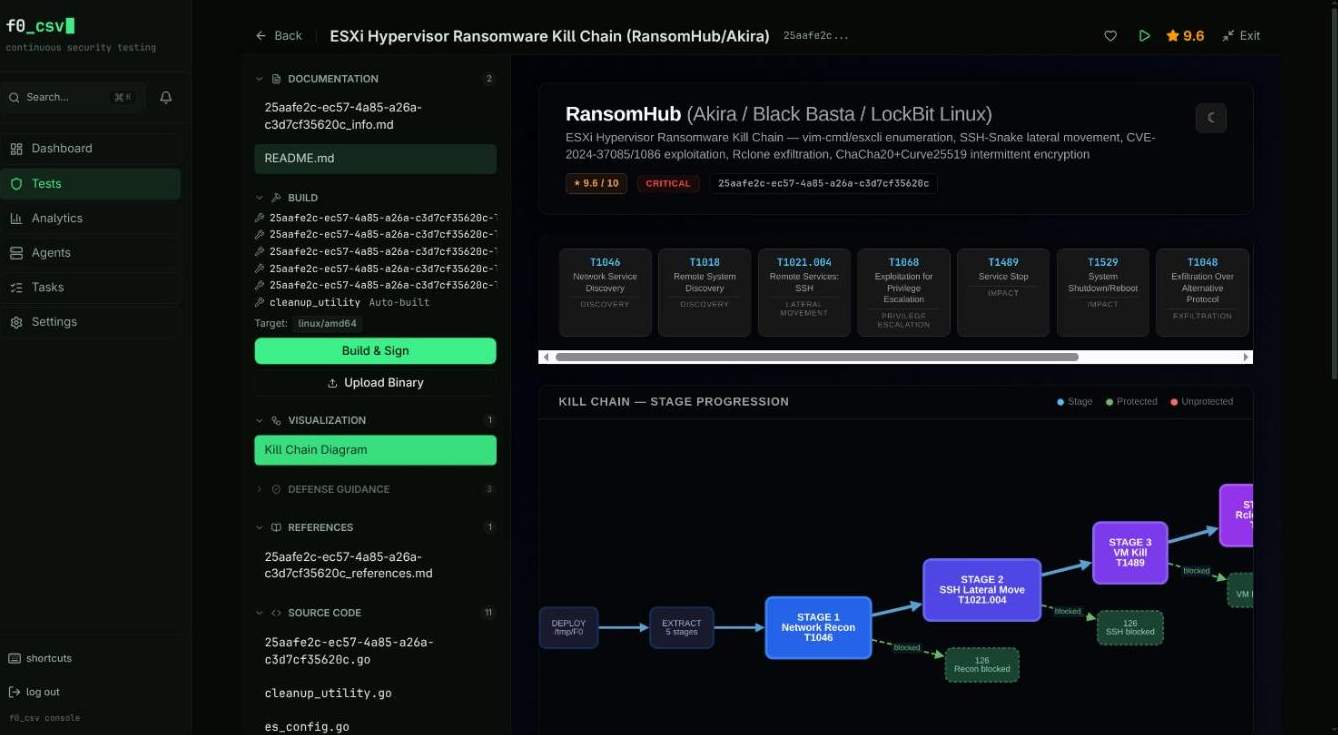
    Detection Rules (5 formats) │ Defense Guidance │ Documentation │ Kill Chain Diagrams
    ↓ Phase 3: Validation & Deployment
    Verifies all artifacts → syncs catalog → deploys to endpoints
What each test package contains:
| Artifact | Formats | Purpose |
|---|---|---|
| Test binary | Go (Windows, Linux, macOS) | Executes the simulated technique on the endpoint |
| Detection rules | KQL, YARA, Sigma, Elastic EQL, LimaCharlie | Import directly into your SIEM/EDR |
| Hardening scripts | PowerShell, Bash (Linux + macOS) | Remediate gaps found by the test |
| Documentation | Markdown (README + info card) | MITRE mapping, severity, threat actor context |
| Kill chain diagram | Interactive HTML | Visualizes multi-stage attack flow |
Test categories:
| Category | Description | Example |
|---|---|---|
| Intel-Driven | Real-world attack techniques from APT reports and ransomware analysis | Lazarus group TTPs, Emotet delivery chains |
| MITRE Top 10 | Most common ransomware techniques from MITRE ATT&CK | Process injection, defense evasion, lateral movement |
| Cyber-Hygiene | Configuration validation for endpoint, identity, and cloud security | Defender settings, ASR rules, LSASS protection, MFA |
The test development pipeline lives in a companion repository. Tests are synced to ProjectAchilles via Git for browsing, building, and execution.
Test Browser
Browse the full test library with rich metadata and execute tests directly from the UI.
- Filter and search by MITRE ATT&CK technique, platform, category, and severity
- View details including source code, detection rules, hardening scripts, and attack flow diagrams
- Build, sign, and download test binaries directly from test detail pages
- MITRE ATT&CK coverage chart with per-tactic bar visualization
- Execution drawer — assign and run tests directly from the browse page
- Favorite tests, track recent views, view version history and Git modification dates
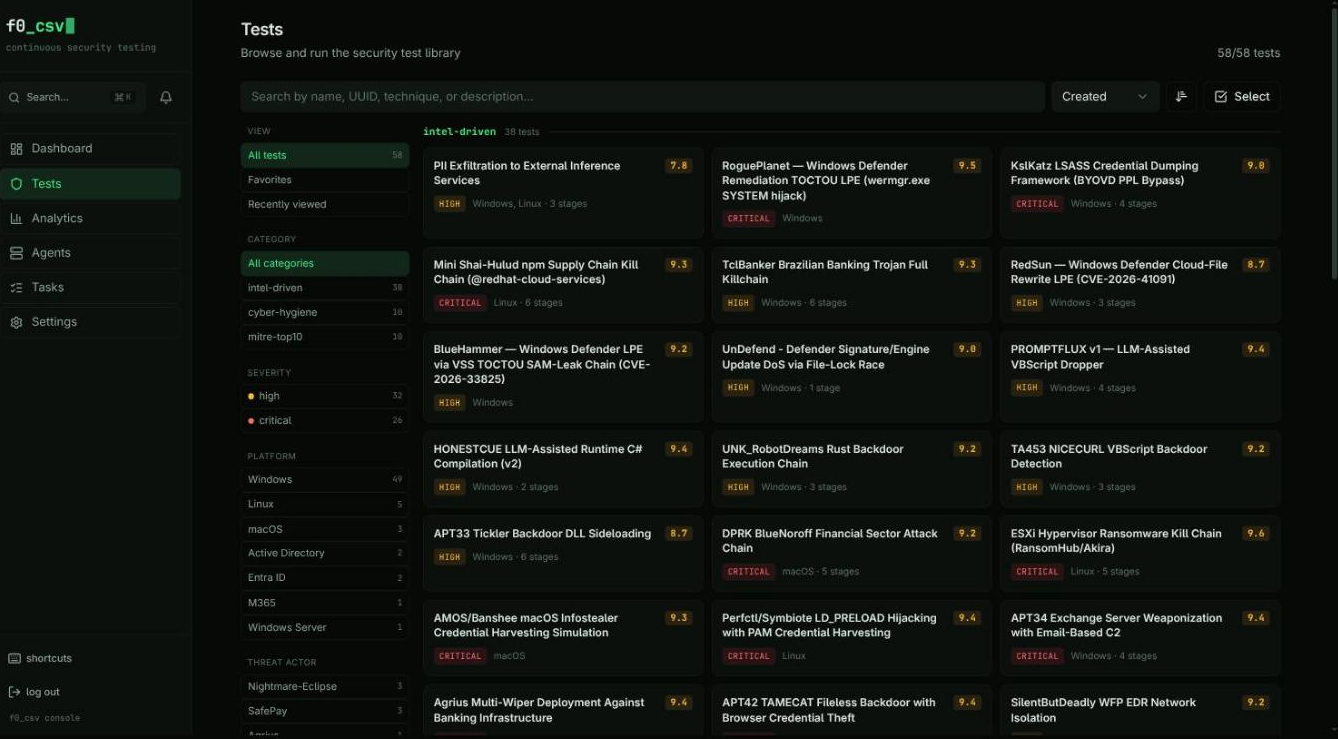
Tests can come from an upstream Git repository (auto-synced) or from custom local directories. Both sources are indexed with collision-free UUIDs. See Custom Tests for details.
Analytics & Measurement
Quantify your security posture with 30+ query endpoints powered by Elasticsearch.
| Feature | Description |
|---|---|
| Defense Score | Aggregate score with breakdowns by test, technique, category, hostname, and severity |
| Trend Analysis | Rolling-window defense score and error rate trends over time |
| MITRE ATT&CK Heatmaps | Host-test matrix showing protection status across your fleet |
| Coverage Treemaps | Hierarchical category/subcategory coverage visualization |
| Execution Table | Paginated results with advanced filtering (technique, hostname, threat actor, tags) |
| Multi-Index | Switch between Elasticsearch indices, create new ones, view index metadata |
| Defender Integration | Dedicated Defender tab — per-execution detection rate, Secure Score, alert correlation, MITRE technique overlap, and opt-in alert auto-resolution |
| Risk Acceptance | Accept risk on individual controls with audit tracking |
| Trend Alerting | Threshold-based Slack and email notifications with in-app notification bell |
| Archive Executions | Archive old execution results to declutter active views |
Execution Framework
Deploy a lightweight Go agent to endpoints for remote test execution with full lifecycle management.
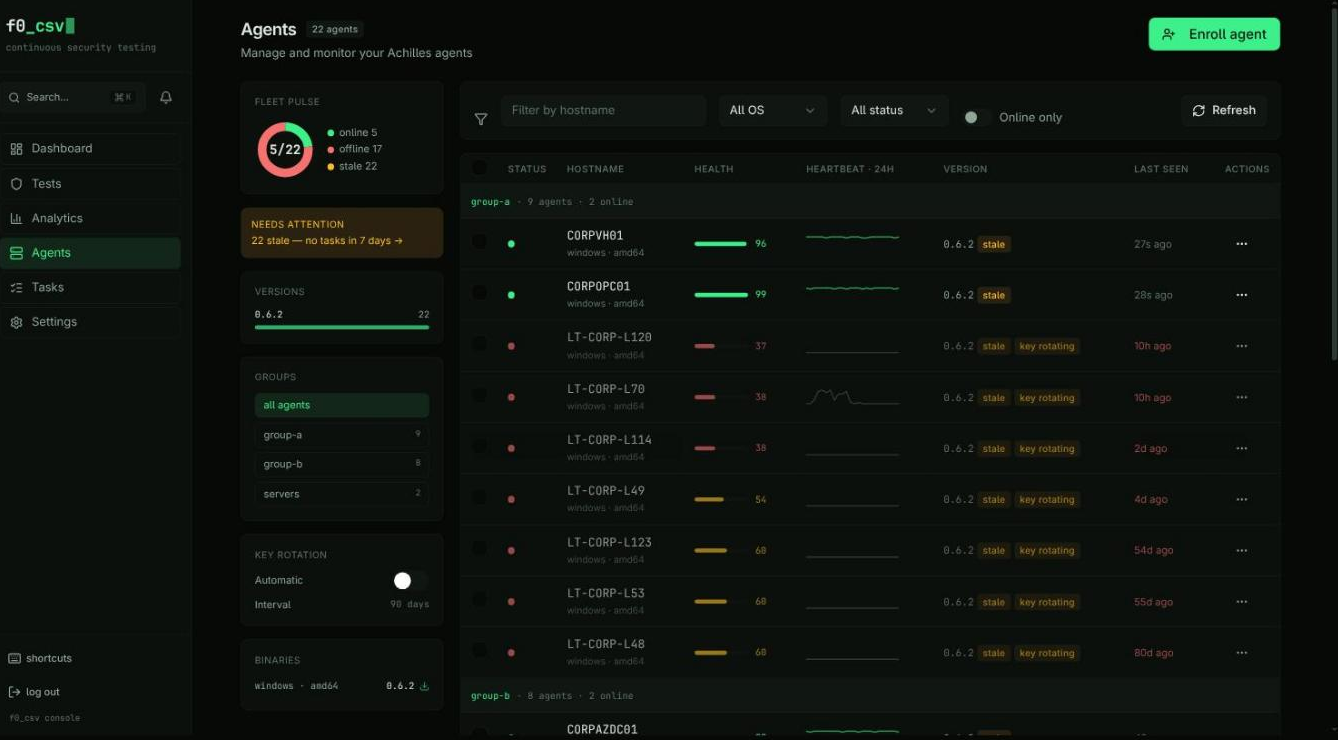
- Enrollment — Token-based registration with configurable TTL and max uses
- Heartbeat Monitoring — Real-time online/offline status with CPU, memory, disk, and uptime metrics
- Task Execution — Download, verify (SHA256 + Ed25519 signature), execute, and report results with stdout/stderr capture
- Self-Updating — Agents poll for new versions and auto-apply cryptographically signed updates
- Zero-Downtime Key Rotation — Rotated API keys delivered automatically via heartbeat with 5-minute dual-key grace period
- Encrypted Config — Agent credentials encrypted at rest with AES-256-GCM using machine-bound keys
- Tagging — Organize agents with custom tags for filtering and bulk operations
- Cross-Platform — Windows, Linux, and macOS support (amd64 + arm64)
- Bundle Results — Reads per-control results from cyber-hygiene bundles for granular compliance tracking
- Remote Uninstall — Two-phase agent removal (stop service + cleanup) initiated from admin UI
- Agent Diagnostics — Enhanced
--statusflag showing service state, connection health, and config validation - Stale Task Detection — Tasks auto-fail when agent goes offline during execution
- Disconnect Reason Reporting — Agents report why they went offline (service restart, machine reboot, network recovery, update restart) on reconnection
- Automatic Task Retry — Tasks that fail due to agent offline are automatically retried (up to 2x) when the agent reconnects
- Agent Health Score — Per-agent reliability score (0–100) based on heartbeat consistency, task success rate, and connection stability
- Offline Alerting — Configurable alerts for agent offline duration, connection flapping, and fleet online percentage via Slack/email
- Local Result Queue — Test results are persisted locally and delivered later if the server is unreachable during reporting
- Adaptive Heartbeat Backoff — Heartbeat frequency automatically reduces during extended outages and snaps back on recovery
Platform Support
| Platform | Architecture | Service Manager | Code Signing | System Info |
|---|---|---|---|---|
| Windows | amd64 | SCM (sc.exe) | Authenticode (osslsigncode) | WMI/native |
| Linux | amd64 | systemd | None | /proc, /etc |
| macOS | amd64, arm64 | launchd (plist) | Ad-hoc (rcodesign) | sysctl, vm_stat |
Build System
Compile and sign test binaries on demand with Go cross-compilation.
- Cross-Compilation — Build for Linux/Windows/macOS x amd64/arm64 from any host OS
- Code Signing — Windows Authenticode signing via osslsigncode, macOS ad-hoc signing via rcodesign
- Multi-Certificate Management — Upload PFX/P12 or generate self-signed certs (up to 5)
- Embed Dependencies — Detects
//go:embeddirectives and allows uploading required files - Build Caching — Previously built binaries cached for instant download
Task Scheduling
Automate test execution across agent pools with flexible scheduling.
- Schedule Types — Once, daily, weekly (specific days), monthly (specific day)
- Randomized Timing — Optional randomization within office hours for realistic simulation
- Per-Task ES Index — Target specific Elasticsearch indices per task for result isolation
- Task Notes — Editable, version-tracked notes on each task
- Priority Queue — Higher-priority tasks assigned first
Integrations
Microsoft Defender
Sync Secure Score, alerts, and control profiles from Microsoft 365 Defender. A dedicated Defender tab reports the per-execution detection rate — what share of your attack simulations Defender actually caught — alongside alert drill-downs, control ↔ alert linking, and MITRE technique overlap. The opt-in auto-resolve pillar can programmatically resolve Achilles-correlated alerts in Defender so continuous-validation activity doesn't flood the SOC queue.
Alerting
Threshold-based alerting when defense scores drop below configured levels:
- Slack — Block Kit formatted messages via webhook
- Email — Nodemailer with SMTP configuration
- In-App — Notification bell with recent alert history
Console & Navigation
A single dark f0 design language across every screen — terminal-green accent on near-black surfaces, Inter for prose and JetBrains Mono for anything machine-shaped (hostnames, versions, exit codes, IDs).
Navigation is flat: six destinations in a fixed sidebar, with global search and notifications docked under the wordmark.
| Destination | What lives there |
|---|---|
| Dashboard | Unified posture across tests, endpoints, and analytics |
| Tests | The test library with a faceted browse rail |
| Analytics | Defense Score, executions, risk acceptances, Defender |
| Agents | Fleet table plus the fleet-pulse utility rail |
| Tasks | Live task stream, scheduled tasks, and task detail |
| Settings | Integrations, tests, agent binaries, users, API keys |
Keyboard shortcuts: 1–6 jump between destinations, / focuses the page
search, ⌘K / Ctrl+K opens global search, and ? lists every shortcut.
See Console & Navigation for the full tour.
Security Hardening
| Protection | Description |
|---|---|
| TLS Enforcement | skip_tls_verify blocked for non-localhost; explicit --allow-insecure required |
| API Key Rotation | Zero-downtime dual-key rotation with heartbeat delivery |
| Replay Protection | Timestamp validation (5-min window) on all agent requests |
| Binary Verification | SHA256 checksum + Ed25519 signature verification |
| Encrypted Credentials | AES-256-GCM for agent config (machine-bound) |
| Rate Limiting | Per-endpoint budgets (enrollment, device, download, rotation) |
| Semgrep SAST | 11 community rulesets + 11 custom rules in CI |